Learning Center
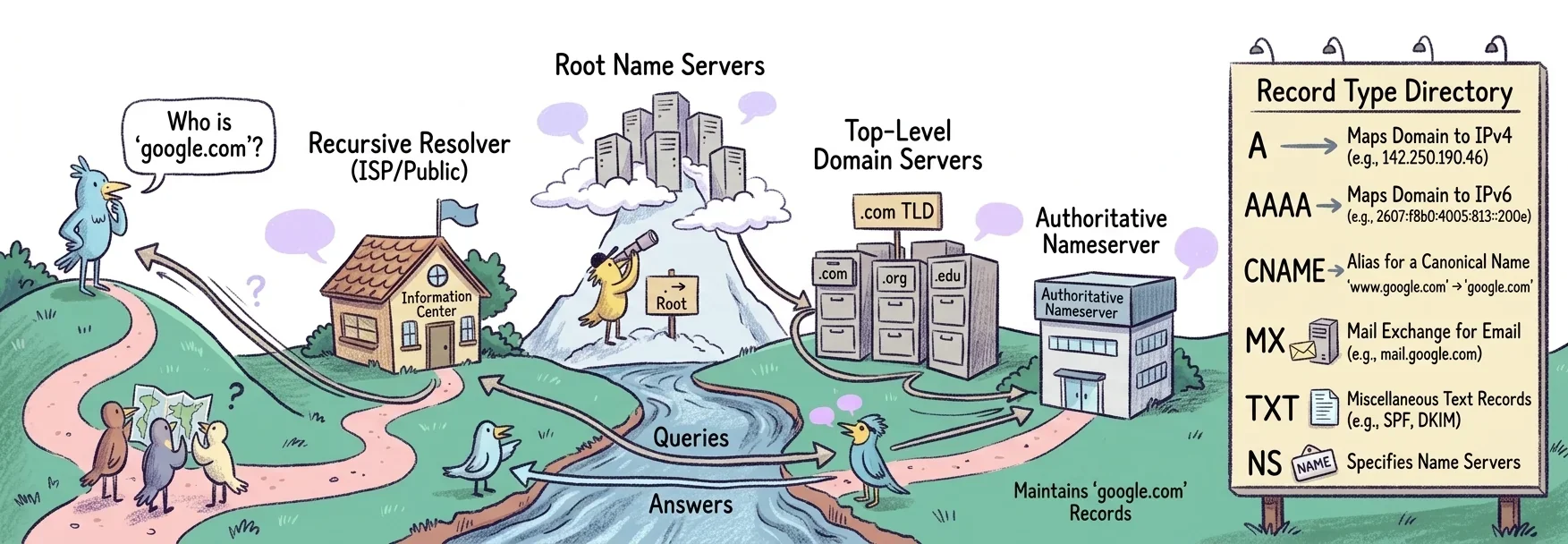
How DNS actually works
Every domain leans on a handful of record types. Here is what each one does, what it looks like in a real lookup, and when you would reach for it.

A Record
A Records are used to point a logical domain name, such as "google.com", to the IP address of Google's hosting server, "74.125.224.147".
Learn moreAAAA Record
An AAAA record does the same job as an A record, but points a domain name at an IPv6 address such as "2607:f8b0:4004:c07::71" instead of an IPv4 one.
Learn moreCNAME Record
A CNAME record is an abbreviation for Canonical Name record and is a type of resource record in the Domain Name System that specifies that the domain name is an alias of another, canonical domain name.
Learn moreMX Record
A mail exchanger record (MX record) is a type of resource record in the Domain Name System that specifies a mail server responsible for accepting email messages on behalf of a recipient's domain.
Learn moreTXT Record
Provides the ability to associate some arbitrary and unformatted text with a host or other name. The TXT record is used to define the Sender Policy Framework and DomainKeys Signed Mail.
Learn moreNS Record
Name server (NS) records determine which servers will communicate DNS information for a domain. Generally, you will have primary and secondary name server records for your domain.
Learn moreSOA Record
A Start of Authority (SOA) record indicates which DNS server is the best source of information for the domain and contains administrative information about the zone.
Learn more